
I didn’t think it would happen like that.
Not after 90 days.
I thought I had crossed some invisible line where things were supposed to stay better. More stable. More “figured out.” But if you’re here, you might already know—that’s not always how it works.
If you’re trying to make sense of a setback, or wondering what kind of support actually helps after something like this, you can explore structured daytime care options. But first, I want to tell you what it actually felt like—because this part matters more than people admit.
The Part No One Prepares You For
Nobody really talks about what happens after you start doing well.
There’s so much focus on getting sober, getting through the first few weeks, hitting milestones. And don’t get me wrong—those things matter.
But somewhere around that 60–90 day mark, things got… quieter.
Not easier. Just quieter.
The urgency faded. The structure loosened. People assumed I was okay—and I wanted to believe that too.
That’s where it started.
Not with a crisis. With a slow drop in vigilance.
It Didn’t Feel Like Giving Up—It Felt Like Earning Freedom
The thought that got me wasn’t reckless.
It was subtle. Almost reasonable.
“I’ve done the work. Maybe I don’t need as much support now.”
That thought felt like growth at the time. Like independence.
I started skipping the things that had been holding me steady. Less structure. Fewer check-ins. More space.
At first, it felt good.
Like taking the training wheels off.
But what I didn’t realize was—I hadn’t fully learned how to ride without them yet.
The Slip Was Quiet… and That’s What Made It Dangerous
There wasn’t a dramatic moment.
No big emotional breakdown. No obvious warning sign.
It was just one decision that didn’t feel like a big deal at the time.
And then another.
And then I crossed a line I had promised myself I wouldn’t cross.
The scariest part?
It didn’t even feel shocking when it happened.
It felt… familiar.
That’s when I knew something deeper had shifted.
The Shame Was Louder Than Anything Else
The relapse itself lasted a moment.
The shame lasted much longer.
It was immediate. Sharp. Personal.
- “You just proved them right.”
- “You wasted all that time.”
- “You’re back at the beginning.”
I didn’t want to reach out.
Not because I didn’t need help—but because I didn’t want to admit I needed more help than before.
That felt like failure.
And for a while, I stayed stuck in that space.
I Tried to Handle It Alone First
I told myself I could correct it quietly.
Get back on track. Reset without anyone knowing.
And for a few days, I tried.
But something was different this time.
The foundation didn’t feel as steady. The confidence I had before wasn’t fully there.
It felt like trying to rebuild something without the right tools.
That’s when it hit me:
“This isn’t something I can stabilize by myself.”
And honestly, that realization was both terrifying and relieving.
Going Back Didn’t Feel Like Failure—It Felt Like Relief
I expected walking back into support to feel humiliating.
Like I’d have to explain myself. Defend what happened.
That’s not what happened.
What I found instead was space.
No lectures. No disappointment.
Just people who understood that relapse isn’t the end—it’s information.
This time, I stepped into a day treatment program. Something structured during the day, but not live-in. I could still go home, still stay connected to parts of my life.
But during the day, I wasn’t drifting anymore.
I had something to hold onto again.
Structure Gave Me Breathing Room
Before, I thought structure meant restriction.
This time, it felt like support.
I didn’t have to wake up and figure out how to hold myself together.
I already had a plan:
- A place to go
- People to talk to
- Time to actually process what I had been avoiding
It took the pressure off pretending I was fine.
And slowly, things started to settle again.
I Started Seeing What I Missed the First Time
This part surprised me the most.
I thought I was just there to “get back” to where I was.
But instead, I started seeing things more clearly.
Patterns I had rushed through before. Emotions I had learned to manage—but not fully understand.
I realized I hadn’t failed recovery.
I had just moved through it faster than I was ready for.
And this time, I wasn’t rushing.
The Reset Was Different Than Starting Over
This wasn’t day one again.
That’s important.
I still had everything I had learned before. The awareness. The experience. The proof that I could do this.
But now I had something else too:
A clearer understanding of where I needed more support.
That made the second attempt feel stronger—not weaker.
If You’re Sitting in That In-Between Space
If you’ve relapsed after having some time, you might be feeling stuck between two identities.
Not where you were before. Not where you want to be.
That space can feel confusing.
But it’s also where real growth can happen—if you don’t isolate in it.
You don’t have to disappear because of this.
You don’t have to figure it out alone.
You Didn’t Lose Everything—You Learned Something Important
I know it might not feel like that right now.
It might feel like everything you built is gone.
But it’s not.
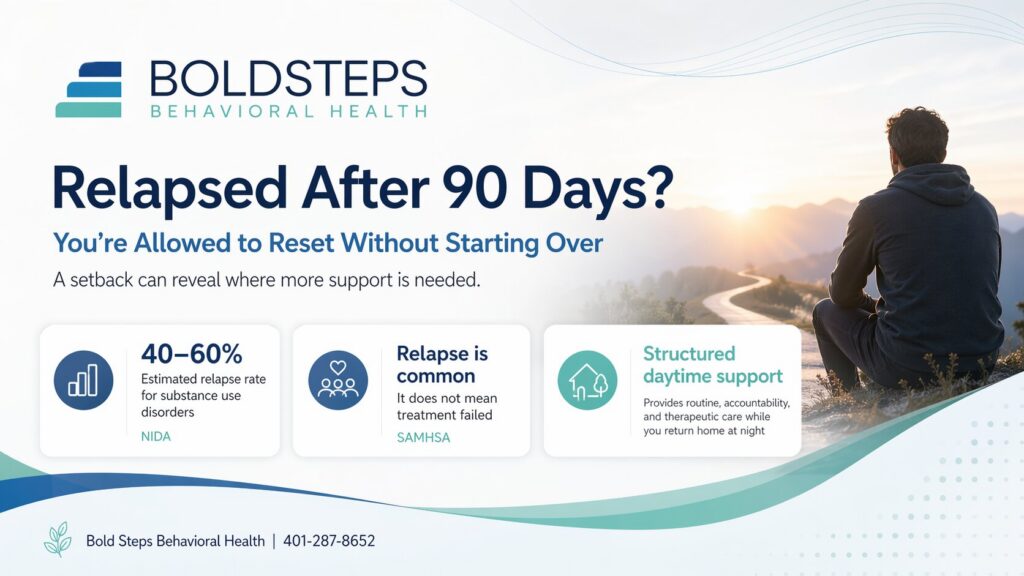
Relapse doesn’t erase progress. It reveals where more support is needed.
And that’s something you can actually work with.
Frequently Asked Questions
Is relapsing after 90 days common?
Yes—more common than people talk about. Early recovery is still a vulnerable time, even if things seem stable on the surface.
Does relapse mean treatment didn’t work?
No. It often means something in your support system needs to be adjusted or strengthened—not that the effort was wasted.
Why did it feel easier to relapse than I expected?
Because your brain and body remember old patterns. Even after time away, those pathways can still feel familiar and accessible.
What makes structured daytime support different after relapse?
It offers consistency, accountability, and space to process what happened—without removing you from your everyday life completely.
How do I know if I need more support this time?
If you’re struggling to stabilize on your own, feeling overwhelmed, or unsure how to move forward—that’s a strong sign more support could help.
What if I feel ashamed to go back?
That feeling is normal—but it’s also one of the biggest barriers to getting the help that actually makes a difference. You’re not the only one who’s been here.
You’re Allowed to Reset Without Starting Over
This doesn’t have to be the end of your progress.
It can be a turning point.
A moment where you stop trying to do it perfectly—and start doing it with support that actually fits.
That’s what changed things for me.
Not willpower. Not pressure.
Support.
If any part of this felt familiar, you don’t have to carry it alone. Call 401-287-8652 or visit our structured daytime care options to learn more about our partial hospitalization program services in Rhode Island.