
It doesn’t usually feel like avoidance.
It feels like thinking. Weighing options. Being careful.
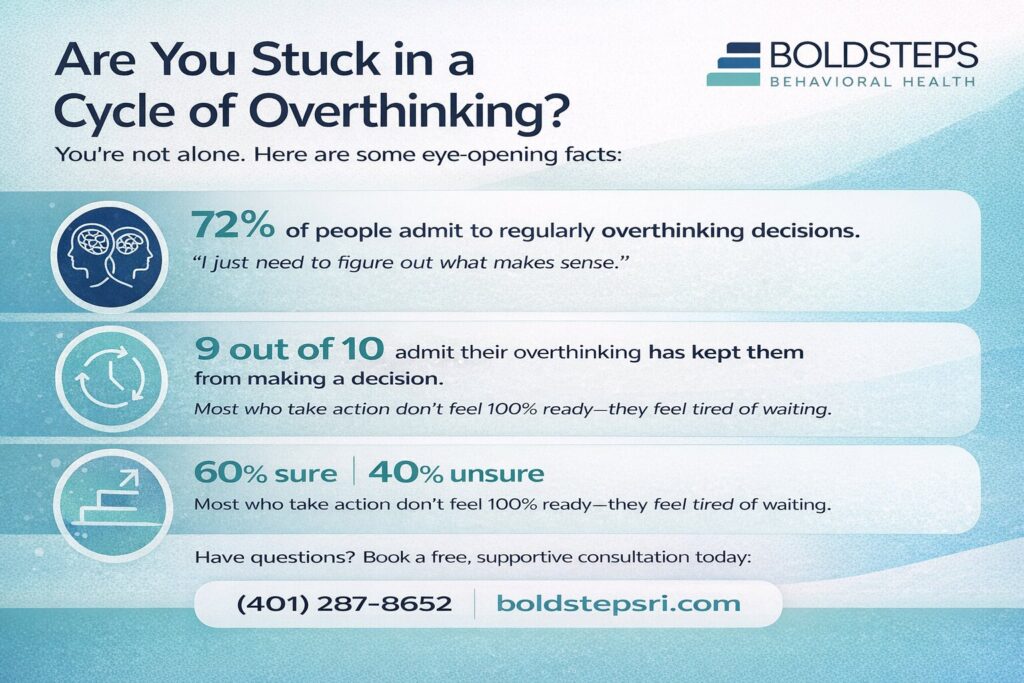
“I just need to figure out what makes sense.”
“Let me research a little more.”
“I’ll decide soon.”
But if you’re honest, you might notice something underneath all of that:
You’ve been here before.
Same thoughts. Same debate. Same pause.
At some point, people land on structured daytime care that actually fits into real life not because they suddenly become certain—but because they get tired of circling the same decision.
Step 1: Recognize That Overthinking Is a Form of Staying Stuck
This part is easy to miss because it feels productive.
You’re comparing options. Reading. Trying to understand things like schedules, costs, or even PHP vs IOP RI.
But underneath all that thinking, ask yourself:
Have I actually moved forward—or just stayed in motion?
There’s a difference.
Overthinking gives you the feeling of progress without requiring change.
And if you’ve been stuck in that loop for a while, it’s not because you’re indecisive.
It’s because part of you is trying to protect you from something.
Step 2: Name What You’re Actually Afraid Of
This is where things get real.
Because the hesitation usually isn’t about logistics. It’s about what this decision means.
It might sound like:
- What if I don’t actually need this and I’m overreacting?
- What if I do it and it doesn’t help?
- What if it changes my life more than I want it to?
- What if I can’t keep up with it?
These are valid fears.
But here’s the shift:
Avoiding the decision doesn’t remove the risk—it just keeps you where you already are.
And if where you are isn’t working, that’s information worth listening to.
Step 3: Stop Waiting for Certainty—It’s Not Coming
This might be the hardest step.
Because your brain wants clarity before action.
But most people don’t feel certain before they start.
They feel:
- 60% sure
- 40% unsure
- And 100% tired of how things have been
That’s enough.
You don’t need certainty to move forward.
You need willingness.
Even a small one.
Step 4: Understand What You’re Actually Choosing Between
A lot of people think the decision is:
Do nothing… or completely disrupt your life.
But that’s not accurate.
There’s a middle space that often gets overlooked.
Structured daytime care is designed for people who:
- Need more than occasional support
- Don’t need to live in treatment
- Want to stay connected to their daily life
So when you’re comparing options like PHP vs IOP RI, what you’re really deciding is:
- How much structure would actually help me right now?
- Do I need more consistent support during the day?
- Would having a place to go change how my days feel?
This isn’t about extremes.
It’s about fit.
Step 5: Shrink the Decision Down to One Step
One of the reasons people stay stuck is because they make the decision too big.
“What if I start and can’t follow through?”
“What if I pick the wrong thing?”
So instead, shrink it.
The decision isn’t:
“Am I committing to this entire process?”
It’s:
“Am I willing to take one step to learn more?”
That step could be:
- Calling and asking what a typical day looks like
- Understanding your schedule options
- Asking about insurance or coverage
You don’t have to commit. You just have to move.
Step 6: Let Go of the Idea That You Should Be Able to Handle This Alone
This one hits a little deeper.
A lot of people stay stuck because they believe:
“If I were stronger, I wouldn’t need this.”
But strength isn’t about doing everything on your own.
It’s about recognizing when something isn’t working—and choosing support anyway.
Needing more structure doesn’t mean you’ve failed.
It means you’re responding honestly to what’s happening.
Step 7: Notice What Changes When You Stop Delaying
Something subtle but powerful happens when you take even one step forward.
The noise quiets.
Not completely—but enough.
Because you’re no longer stuck in the loop of “Should I or shouldn’t I?”
You’re in motion.
And motion—even small—creates relief.
It replaces pressure with possibility.
Step 8: Let This Be a Starting Point, Not a Final Decision
You don’t have to figure out everything today.
You don’t need to commit to months of anything.
You just need to shift out of indecision.
Let this be a starting point.
A conversation. A question. A step.
Because staying where you are—that’s still a decision too.
And if it hasn’t been working, it’s okay to choose something different.
FAQ: The Questions You’re Probably Asking (But Might Not Say Out Loud)
What if I start and realize I don’t need this level of care?
That’s okay. Starting doesn’t lock you in forever. It gives you more clarity about what actually helps—and what doesn’t.
How many hours a day does this usually take?
Structured daytime care typically involves several hours a day, multiple days a week. It’s designed to give enough support to make a real difference—without removing you from your life completely.
Can I still work or handle responsibilities?
In many cases, yes—with adjustments. Some people shift schedules or work part-time while getting support. It’s about finding a balance that works.
What’s the real difference between higher and lower levels of care?
It often comes down to time and consistency. When people compare things like PHP vs IOP RI, they’re usually deciding how much daily support they need to feel stable.
What if I’m not “bad enough” for this?
You don’t need to reach a breaking point to deserve support. If something isn’t working, that’s reason enough to explore other options.
What if I lose motivation halfway through?
That’s part of the process. Structured care isn’t built on motivation—it’s built on consistency. You don’t have to feel ready every day to keep showing up.
What if I’m still unsure after reading all this?
That’s normal. Uncertainty doesn’t mean no—it just means you’re human. The next step doesn’t require certainty, just curiosity.
You don’t have to keep having the same conversation with yourself.
At some point, relief comes from choosing—not perfectly, not completely—but honestly.
Call (401) 287-8652 or visit our partial hospitalization program Rhode island services to learn what getting support could actually look like—without pressure, and on your terms.