
Most People Don’t Realize This Is When More Support Is Needed

Most People Don’t Realize This Is When More Support Is Needed

You can feel it before you can fully explain it.

Something has shifted. What used to help—therapy, medication, routines—doesn’t seem to be reaching your child the same way anymore.

And now you’re left watching it unfold, trying to decide: Is this something we wait out… or something we need to act on?

At a higher level of structured daytime support, this is one of the most common moments families arrive in—not at the beginning, but in the middle of uncertainty, when what used to work no longer feels like enough.

It’s Not That Nothing Is Working—It’s That It’s Not Holding

This is an important distinction, and one that often gets missed.

Your child’s therapy may have helped. Their medication may have brought relief at one point.

But right now, it’s not holding.

The support exists—but it’s not strong enough to carry what they’re dealing with day-to-day.

This is often when parents start searching things like therapy not working depression. Not because they’ve lost hope—but because they’re trying to understand why progress feels like it’s slipping.

And the answer is often not failure.
It’s a mismatch between the level of support and the intensity of what’s happening.

What a Downward Shift Can Actually Look Like

It doesn’t always look like a crisis at first.

Sometimes it’s subtle. Quiet. Easy to second-guess.

You might notice:

  • They’re withdrawing more, even from safe or familiar people
  • Their energy is low in a way that doesn’t lift
  • Their sleep patterns are off—too much, too little, or inconsistent
  • Things that used to help (therapy, coping skills, routines) don’t seem to land
  • They feel stuck in negative thoughts they can’t interrupt

There’s often a feeling underneath it all that’s hard to describe:
They’re here, but not fully here anymore.

That’s the moment many parents start asking, What do we do now?

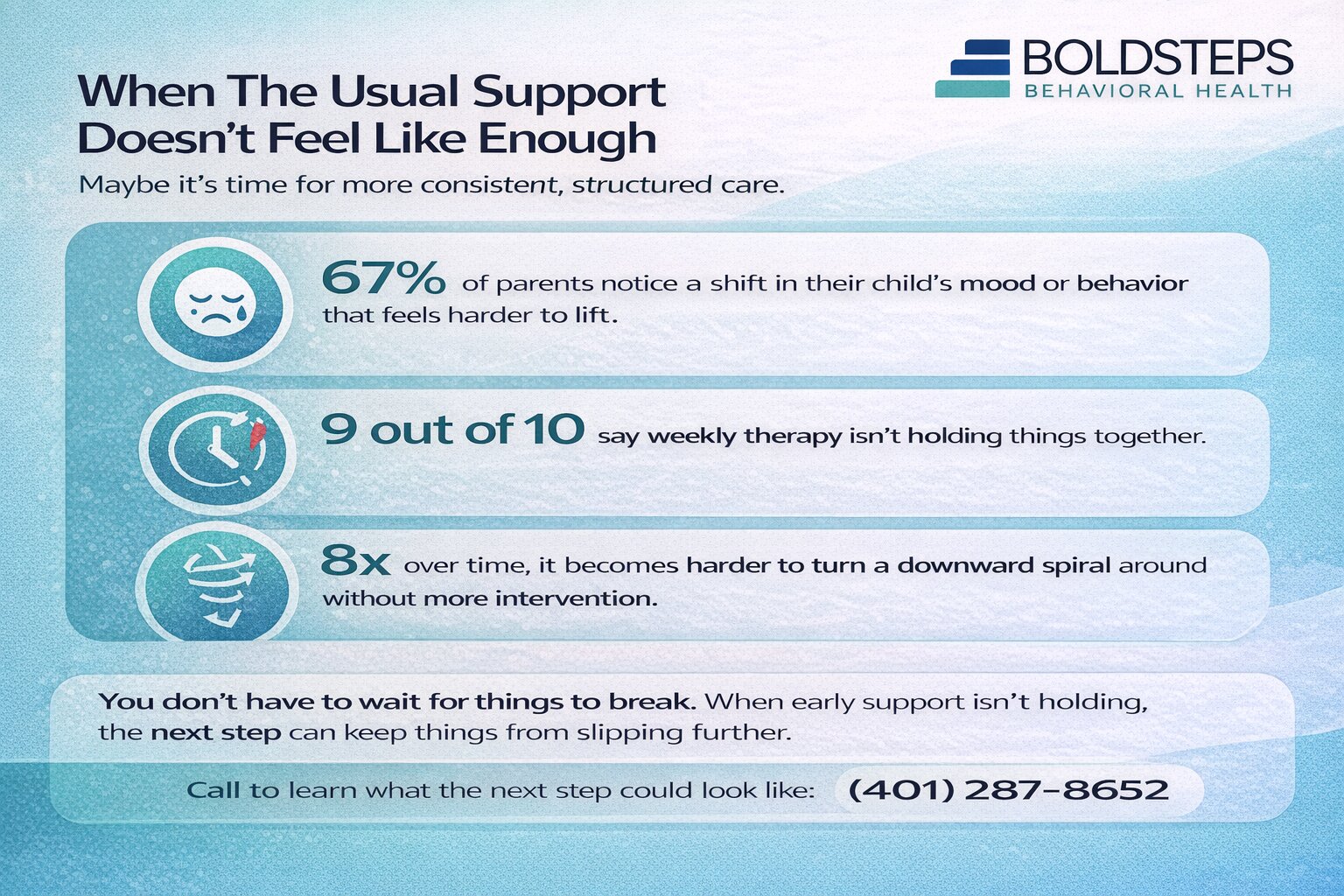
Why Weekly Therapy Can Start to Feel Like Too Little, Too Late

Outpatient therapy plays an important role. It gives space for reflection, processing, and learning.

But when someone is struggling more intensely, once-a-week support can feel like trying to catch up to something that’s constantly moving.

Too much happens in between.

A difficult morning can turn into a full day. A bad day can turn into a hard week. By the time the next session comes, the conversation is already behind the experience.

It’s not that therapy stops working.
It’s that the gap between sessions becomes too wide for what your child is dealing with.

The Missing Piece Is Often Daily Structure

When someone is spiraling, the hardest hours are usually the unstructured ones.

Long stretches of time without direction.
Too much space for thoughts to take over.
Not enough support in the moments things actually escalate.

Structured daytime care focuses on those exact hours.

It gives your child:

  • A place to go consistently during the day
  • Support in real time—not just after something happens
  • A rhythm that replaces unpredictability
  • Opportunities to practice coping skills while they’re needed

For many families, this fills the gap that therapy alone couldn’t.
What Parents Often Ask at This Stage

Support That Doesn’t Remove Them From Their Life

One of the biggest concerns parents have is whether more support means pulling their child completely out of their environment.

That’s not always necessary.

With structured daytime care, your child receives consistent support during the day—but returns home at night.

This balance matters.

It allows them to:

  • Stay connected to home and family
  • Practice what they’re learning in real-life situations
  • Maintain a sense of independence
  • Avoid the shock of transitioning from full isolation back into daily life

It’s not about removing them from their world.
It’s about helping them function inside it again.

Why This Level of Care Can Feel Like a Turning Point

When the right level of support is in place, the goal isn’t instant transformation.

It’s stabilization.

Small shifts begin to happen:

  • Their days feel more predictable
  • Their thoughts feel less overwhelming
  • They’re not carrying everything alone
  • They begin to rebuild trust in themselves

And for parents, there’s often a subtle but powerful change too.

You’re no longer trying to hold everything together by yourself.
There’s a shared structure. A team. A plan.

That alone can bring a sense of relief.

You’re Not Overreacting—You’re Responding

It’s incredibly common for parents to question themselves at this stage.

Maybe we should give it more time.
Maybe this is just a rough patch.
Maybe I’m overthinking it.

But when you’ve watched something change—and especially when what used to help isn’t helping anymore—that’s not overreaction.

That’s awareness.

And responding to that awareness is what creates the opportunity for things to shift before they get worse.

You Don’t Have to Have the Perfect Plan

There’s a pressure to “get it right” when your child is struggling.

To choose the exact right next step. To avoid making things worse.

But most families don’t start with certainty.

They start with a question: What would actually help right now?

And sometimes, the answer isn’t more of the same.
It’s a different level of support—one that meets your child where they are today, not where they were a few months ago.

FAQ: What Parents Often Ask at This Stage

How do I know if my child needs more support than therapy?

If their symptoms are getting worse, staying the same despite effort, or interfering with daily functioning, it may be time to consider more consistent support during the week.

Will this replace their current therapist or medication?

Not necessarily. Structured care often works alongside existing support, creating a more comprehensive approach rather than replacing what’s already in place.

What if my child resists the idea of more help?

That’s common. Resistance doesn’t always mean refusal—it often reflects fear, exhaustion, or uncertainty. A different structure can feel more approachable than repeating what didn’t work before.

Is this only for severe situations?

No. This level of care is often most effective before things reach a crisis point. It’s about providing enough support early enough to prevent escalation.

Will they still be able to live at home?

Yes. They return home each evening, which allows them to stay connected to family while receiving daily support.

How long does someone usually stay in this type of care?

It varies based on individual needs. The goal is to provide enough time for stabilization and meaningful progress—not to rush the process.

What if we’re unsure about taking the next step?

That’s okay. You don’t have to commit immediately. Starting with a conversation can help you understand what options are available and what might fit best.

There Is a Middle Ground Between “Fine” and “Crisis”

One of the hardest parts of this experience is feeling like your options are limited.

Wait and hope things improve…
Or wait until things get worse.

But there is a middle ground.

A place where your child can receive more support without being removed from their life.
A place where things can stabilize before they spiral further.

You don’t have to wait for things to break to take action.

Call (401) 287-8652 or visit our partial hospitalization program Rhode island services to learn more about how structured daytime care can support your child—and your family—right now.


Are You Covered for Addiction Treatment? Find Your Insurance.

Contact Us 24/7

Friendly Operators are Standing By

Inner Form

Name(Required)

Quick Answer

Will group therapy be part of my plan?
Yes — group therapy is a cornerstone of every Bold Steps program.

Best fit if you struggle with: isolation, shame, difficulty opening up, relapse triggers, or needing accountability.

Pairs with: CBTDBTTrauma TherapyEMDRFamily Therapy, and our Alumni Program.

Where you’ll get it: Offered across Day TreatmentNight Treatment, and Outpatient programs; format and frequency adjust by level of care.

Estimated Time To Complete: ~2 mins

Who needs help? *

We’re here to help with your recovery. Please fill out this short form so our team can
understand your needs.

Myself

Myself

If you have any further questions about treatment, you may contact us directly at (888) 440-4306

Quick Answer

Will family therapy be part of the plan?
Almost always, yes. Bold Steps includes a free weekly virtual Family Support Group (open to loved ones even if their family member isn’t in treatment), plus scheduled family therapy sessions as part of treatment.

Best fit if your family struggles with: broken trust, enabling patterns, miscommunication, resentment, or uncertainty about how to help.

Pairs with: CBTDBTTrauma TherapyEMDRFamily Therapy, and our Alumni Program.

Where you’ll get it: Across all levels of care — DayHalf-DayOutpatient — plus our virtual group accessible from anywhere.

Estimated Time To Complete: ~2 mins

Who needs help? *

We’re here to help with your recovery. Please fill out this short form so our team can
understand your needs.

Myself

Myself

If you have any further questions about treatment, you may contact us directly at (888) 440-4306

Quick Answer

Will EMDR be part of my plan?
Likely if you struggle with trauma memories, flashbacks, nightmares, panic tied to past events, or relapse linked to trauma triggers.

What EMDR pairs well with: DBT for emotion stabilization, CBT for thought reframing, MAT for cravings that block therapy work, and mindfulness/yoga for grounding.

Where you’ll get it: Often in Day Treatment or Night Treatment programs, once you’ve built some stabilization skills.

Estimated Time To Complete: ~2 mins

Who needs help? *

We’re here to help with your recovery. Please fill out this short form so our team can
understand your needs.

Myself

Myself

If you have any further questions about treatment, you may contact us directly at (888) 440-4306

Quick Answer

Will DBT be part of my plan?
Likely if you struggle with big emotion swings, impulsive actions (including substance use), self-harm urges, relationship blowups, or relapse tied to “I can’t handle this feeling.”

What DBT pairs well with: CBT for thought work, trauma therapy like EMDRMAT for opioid cravings, or mindfulness/yoga for nervous system reset.

Where you’ll get it: Day TreatmentNight Treatment, or Outpatient — intensity depends on your level of care.

Estimated Time To Complete: ~2 mins

Who needs help? *

We’re here to help with your recovery. Please fill out this short form so our team can
understand your needs.

Myself

Myself

If you have any further questions about treatment, you may contact us directly at (888) 440-4306

CBT at Bold Steps: Will This Be Part of My Plan? Quick Answer

Will CBT be part of my plan?
Likely if you’re dealing with racing thoughts, catastrophic thinking, relapse triggers, shame spirals, avoidance, panic, or insomnia.

We may combine it with: DBT for emotion regulation, EMDR for trauma, MAT for opioid cravings, or mindfulness/yoga for calming your nervous system.

Where you’ll get it: CBT is woven into Day TreatmentHalf-Day Treatment, and Outpatient care.

Estimated Time To Complete: ~2 mins

Who needs help? *

We’re here to help with your recovery. Please fill out this short form so our team can
understand your needs.

Myself

Myself

If you have any further questions about treatment, you may contact us directly at (888) 440-4306

Support for the People Who Love You

When it helps, we include family—on your terms. We offer education, boundary coaching, and ways to rebuild trust while keeping your privacy and safety at the center.

We cover:

  • What to say (and not say)
  • Healthy support vs. enabling
  • How to help between sessions

Estimated Time To Complete: ~2 mins

Who needs help? *

We’re here to help with your recovery. Please fill out this short form so our team can
understand your needs.

Myself

Myself

If you have any further questions about treatment, you may contact us directly at (888) 440-4306

Care That Fits Your Schedule

Recovery is easier when care works with your real life. Choose daytime structure or evening groups—both with evidence-based therapy and a clear weekly plan. Switch times if your schedule changes.

Highlights:

  • Predictable weekly calendar
  • Missed-session catch-ups
  • Option to step up or down

Estimated Time To Complete: ~2 mins

Who needs help? *

We’re here to help with your recovery. Please fill out this short form so our team can
understand your needs.

Myself

Myself

If you have any further questions about treatment, you may contact us directly at (888) 440-4306

Find the Right Level of Care

Treatment should match your life—not the other way around. We’ll recommend a level that fits your symptoms, safety needs, and schedule so progress sticks at home, work, and school.

Options include:

  • Day Treatment  
  • Night Treatment  
  • Outpatient & step-downs

Estimated Time To Complete: ~2 mins

Who needs help? *

We’re here to help with your recovery. Please fill out this short form so our team can
understand your needs.

Myself

Myself

If you have any further questions about treatment, you may contact us directly at (888) 440-4306

Your Journey To Recovery Starts Now

Boldsteps Behavioral Health offers same-day admission for those seeking help for substance use disorder. Our simple admissions process takes just minutes. Call today for a free, private consultation.

Estimated Time To Complete: ~2 mins

Who needs help? *

We’re here to help with your recovery. Please fill out this short form so our team can
understand your needs.

Same Day Admission

Myself

Myself

If you have any further questions about treatment, you may contact us directly at (888) 440-4306

Verify Your Benefits in 2 Minutes

We’ll check your coverage and explain your options in plain language—no pressure, no jargon. Most plans include part of treatment; we’ll confirm what’s in-network and your estimated out-of-pocket before you decide.

You’ll get:

  • Eligibility + deductible summary
  • Programs your plan covers
  • Next-step timeline

Estimated Time To Complete: ~2 mins

Who needs help? *

We’re here to help with your recovery. Please fill out this short form so our team can
understand your needs.

Myself

Myself

If you have any further questions about treatment, you may contact us directly at (888) 440-4306

Proven Care, Whole-Person Support

We combine therapies that work—CBT, DBT skills, medication management—with holistic supports like mindfulness, movement, and creative groups. You’ll build practical tools you can use the same day.

You’ll practice:

  • Craving + emotion skills
  • Relapse-prevention planning
  • Sleep, nutrition, and routines

Estimated Time To Complete: ~2 mins

Who needs help? *

We’re here to help with your recovery. Please fill out this short form so our team can
understand your needs.

Myself

Myself

If you have any further questions about treatment, you may contact us directly at (888) 440-4306