
You wake up, and something feels off. Your hands are unsteady. Your chest feels tight. Your thoughts are louder than they should be.
It’s not just a hangover—and part of you knows it.
If you’ve found yourself searching for answers, you’re not alone. And if you’re quietly wondering whether it’s time to get help, you’re already closer than you think. You can explore alcohol addiction treatment services anytime—but first, let’s slow this down and make sense of what your body might be trying to tell you.
That Morning Feeling Isn’t Just “In Your Head”
There’s a specific kind of morning-after feeling that’s hard to explain unless you’ve felt it.
It’s not just dehydration or a headache. It’s deeper than that.
Your hands might tremble slightly while holding your phone. Your heart feels like it’s beating faster than it should. There’s a low, buzzing anxiety sitting in your chest—even if nothing is actually wrong.
This isn’t weakness. It’s not you “overreacting.”
Alcohol impacts your central nervous system. It slows things down while you’re drinking. But when it wears off, your body can rebound in the opposite direction—sometimes sharply.
That rebound is what people often describe as shaking after drinking anxiety.
It’s your nervous system trying to stabilize again.
And the more often this cycle happens, the more noticeable—and uncomfortable—it can become.
The Quiet Question You Might Be Avoiding
These mornings don’t just bring physical discomfort.
They bring questions.
“Was that too much?”
“Why does this keep happening?”
“Is this normal… or is this a problem?”
You might brush it off during the day. Get busy. Move on.
But the question doesn’t fully go away.
And here’s the truth: you don’t need to have a clear answer yet.
You don’t have to decide if you “have a problem.” You don’t need to label yourself.
But that moment of honesty—the one where you pause and wonder—that’s worth paying attention to.
Because it’s often the first sign that something inside you is asking for change.
Why It Feels Worse Than a Typical Hangover
A standard hangover is mostly physical.
This is different. It feels more personal somehow—like your mind and body are both unsettled.
You might notice:
- A sense of unease that doesn’t match your surroundings
- Racing thoughts or overthinking small things
- Trouble sitting still or relaxing
- A strange mix of fatigue and restlessness
It can feel confusing. Even a little scary.
That’s because alcohol doesn’t just affect your body—it affects brain chemistry tied to mood and stress.
So when it wears off, your system isn’t just recovering physically. It’s recalibrating emotionally, too.
That’s why the anxiety can feel so intense, even if nothing specific triggered it.
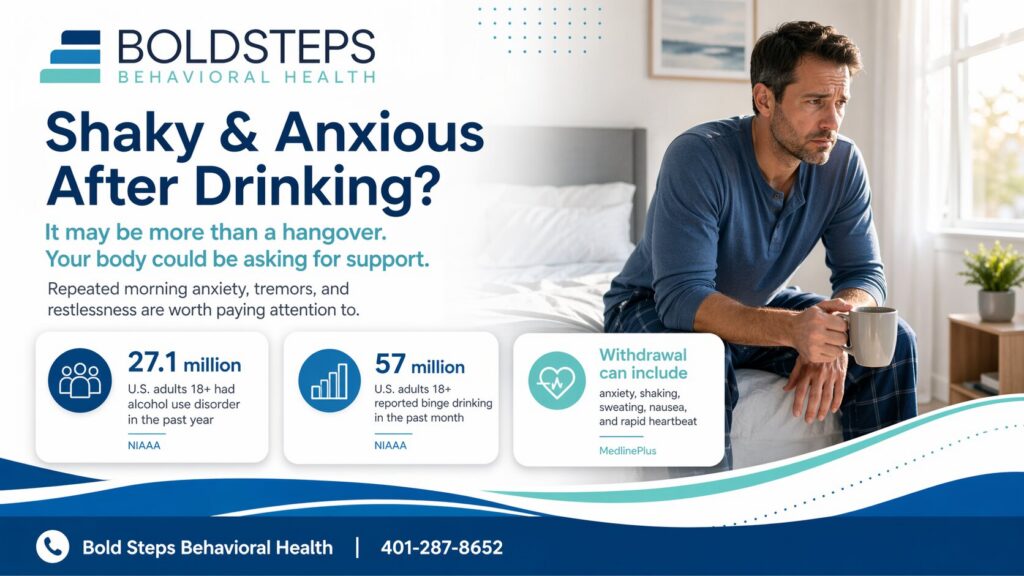
Signs Your Body Might Be Asking for a Different Relationship With Alcohol
You don’t need a diagnosis to notice patterns.
Sometimes it shows up in small, repeatable ways:
- You wake up feeling anxious more often than not after drinking
- The physical symptoms (like shaking or restlessness) are getting stronger
- You promise yourself you’ll drink less—but it doesn’t always go that way
- Nights out feel fun in the moment, but the next day feels heavier than it used to
- You find yourself thinking about your drinking more than you used to
None of these mean something is “wrong” with you.
They just mean your body is responding—and asking you to pay attention.
The Myth That Keeps People Stuck
A lot of people hesitate to reach out for help because of what they think treatment is.
They picture something extreme. Disruptive. Final.
But that version of treatment? It’s outdated.
Today, support can look very different:
- Structured daytime care where you get help during the day and return home at night
- Multi-day weekly treatment that fits into your existing life
- Conversations that focus on understanding your patterns—not judging them
It’s not about losing your freedom.
It’s about gaining clarity and stability—without blowing up your life to get there.
What Getting Help Actually Feels Like
Most people expect it to feel intimidating.
In reality, the first step often feels surprisingly human.
It’s not someone telling you everything you’ve done wrong.
It’s someone helping you understand what’s been happening—and why it makes sense.
There’s space to ask questions. To be unsure. To take things one step at a time.
For many people, it feels like relief.
Not because everything is fixed—but because they’re not carrying it alone anymore.
You Don’t Have to Wait for It to Get Worse
There’s a common belief that you need to hit a breaking point before getting help.
That belief keeps people stuck longer than they need to be.
You don’t have to wait until things fall apart.
If your mornings feel off…
If your body feels unpredictable…
If your thoughts feel heavier than they used to…
That’s already enough of a reason to pause and explore support.
Early support often means a smoother, less overwhelming path forward.
A Different Way Forward
You don’t need to have everything figured out to take a first step.
You don’t need to commit to a major life change overnight.
You just need a space where you can be honest about what’s happening—and where someone knows how to help you make sense of it.
The version of treatment you might be imagining? It’s probably harsher than reality.
Real support is quieter. More flexible. More focused on helping you feel like yourself again.
And it starts with a conversation.
Frequently Asked Questions
Is it normal to feel shaky and anxious after drinking?
It’s common—but that doesn’t mean it should be ignored. Occasional discomfort can happen, but repeated patterns of anxiety and physical symptoms may signal your body is struggling to recover from alcohol.
Why does alcohol cause anxiety the next day?
Alcohol temporarily slows your nervous system. As it wears off, your body can rebound into a heightened state—leading to restlessness, racing thoughts, and physical symptoms like shaking.
Does this mean I’m dependent on alcohol?
Not necessarily. But it can be an early sign that your body is becoming more sensitive to alcohol’s effects. It’s worth paying attention to patterns rather than jumping to labels.
Will these symptoms go away if I stop drinking?
In many cases, yes—your body can rebalance over time. But if symptoms are frequent or intense, having support during that process can make it safer and more manageable.
What if I’m not ready for full treatment?
That’s okay. Many people start with conversations, education, or flexible care options that don’t require a full-time commitment. You’re allowed to take this one step at a time.
How do I know if I should talk to someone?
If you’re asking that question, it’s usually a good sign it’s worth exploring. You don’t need certainty—you just need curiosity and a little willingness to see what support might look like.
If something in this felt familiar, you don’t have to keep figuring it out alone. Call (401) 287-8652 or visit our alcohol addiction treatment services in your area to learn more about your options and what support could look like for you.