
At first, he blamed the coffee.
Too much caffeine. Not enough sleep. Stress from work. Anxiety.
But the shaking kept happening.
Every morning started the same way: waking up already uneasy, hands trembling while trying to answer emails, stomach tight, heart racing for no clear reason. Sometimes it settled after breakfast. Sometimes it didn’t stop until later that night after another drink.
That was the part that scared him most.
Not just the shaking itself. The realization that alcohol seemed to quiet it down.
If you’ve experienced something similar, you are not weak, dramatic, or “too far gone.” And you are certainly not alone. Many people searching for answers about morning trembling after drinking are quietly trying to understand whether their body is asking for help.
For some, that search becomes the first step toward support for alcohol recovery and healing.
It Doesn’t Always Look the Way People Expect
A lot of people assume alcohol addiction has a specific look.
They picture someone who has completely lost control of their life. Someone visibly falling apart. Someone who cannot function day to day.
But many people struggling with alcohol dependence are still going to work every morning. Still parenting. Still paying bills and showing up for responsibilities.
That’s part of what makes it so confusing.
You can be deeply unwell while still appearing “fine” from the outside.
Many first-time treatment seekers tell us they spent years convincing themselves they couldn’t possibly need help because their lives still looked relatively stable.
Meanwhile, their bodies were sending warning signs every day.
The shaking. The nausea. The anxiety. The exhaustion. The constant mental negotiation around drinking.
Sometimes addiction is loud. Sometimes it’s incredibly quiet.
Why Morning Shaking Can Happen After Drinking
Heavy or ongoing alcohol use affects the nervous system over time.
Alcohol slows certain brain functions and changes how the body regulates stress and stimulation. Eventually, the brain starts adapting to alcohol being present regularly.
Then overnight, alcohol levels drop.
For some people, the nervous system reacts strongly to that shift. This can lead to symptoms like:
- Trembling or shaking hands
- Sweating
- Anxiety or panic
- Rapid heartbeat
- Nausea
- Irritability
- Difficulty concentrating
- Feeling physically “off” until drinking again
People experiencing alcohol shakes in morning hours often try hard to hide it.
Some hold coffee cups tightly to steady their hands. Others avoid breakfast meetings because they feel sick or panicked. Some start drinking earlier than they planned simply to feel normal again.
There is usually a great deal of shame wrapped around these experiences.
But shame tends to keep people isolated longer than necessary.
Many People Wait Because They’re Scared of What It Means
There’s a moment many people describe before reaching out for help.
A quiet thought they try hard to push away:
“What if this means I really have a problem?”
That thought can feel terrifying.
Because acknowledging the problem often feels like stepping into the unknown. People worry treatment will change everything overnight. They fear judgment, labels, losing freedom, or being forced into decisions they are not ready for.
So instead, many people try to manage it privately.
They promise themselves they’ll cut back next week. They switch types of alcohol. They set rules. They try “taking breaks.” They spend months—or years—trying to negotiate their way out of something their body may already be struggling to control.
And while all of that is happening, the nervous system keeps getting more overwhelmed.
The mornings keep getting harder.
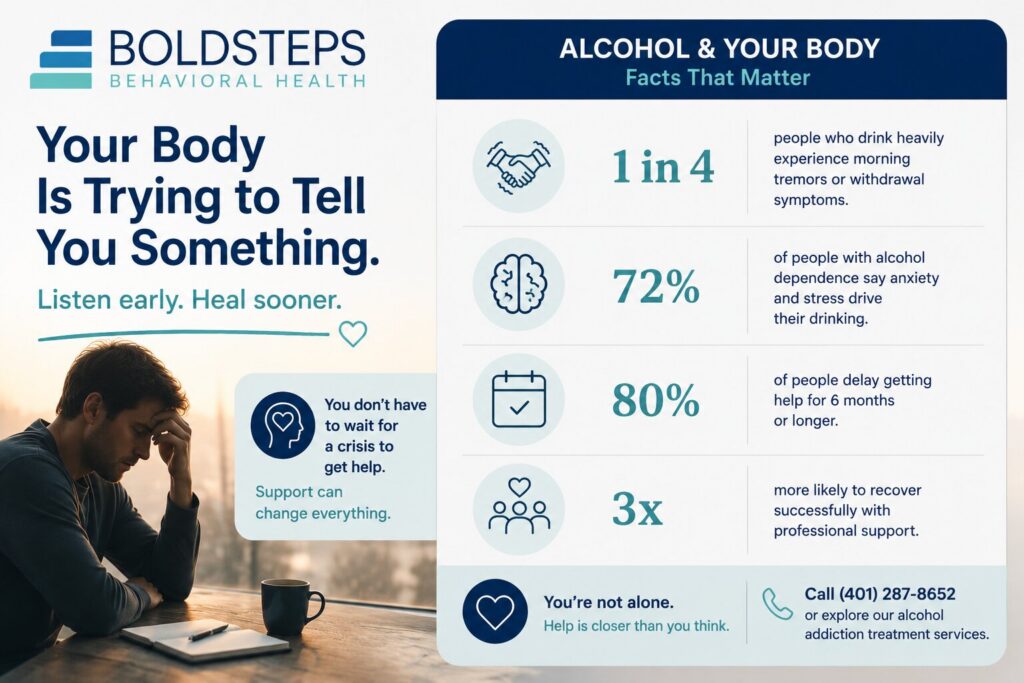
The Body Can Only Compensate for So Long
One of the difficult truths about alcohol dependence is that the body adapts remarkably well—until it can’t anymore.
At first, symptoms may seem mild.
A little shakiness. More anxiety than usual. Trouble sleeping. Feeling sick in the mornings.
Over time, those symptoms can intensify.
Some people notice they need alcohol earlier in the day to feel steady. Others begin experiencing panic, sweating, irritability, or emotional swings that seem impossible to control.
And because the progression is gradual, many people normalize it.
That’s one reason treatment can feel surprisingly emotional for first-time clients. They suddenly realize how long they’ve been operating in survival mode.
One client once described it this way:
“It felt like my nervous system had been clenching for years.”
That kind of exhaustion is difficult to explain unless you’ve lived it.
Treatment Is Often Gentler Than People Expect
A lot of people imagine treatment as something harsh or extreme.
They picture losing their independence or being judged the moment they walk through the door.
But for many people, the first feeling is actually relief.
Relief that someone understands what’s happening physically and emotionally. Relief that they no longer have to pretend everything is under control. Relief that there may actually be a safe way forward.
At Boldsteps RI, we often work with people who are entering treatment for the first time and feeling deeply unsure.
Some are frightened by their symptoms. Others are embarrassed they waited so long. Many are worried they will not “fit in” because their lives still appear functional from the outside.
What they usually discover is this: they are far from the only person carrying those fears.
Real Recovery Stories Rarely Begin With Confidence
One of the biggest myths about recovery is that people enter treatment feeling fully ready and certain.
Most don’t.
Many people arrive scared, skeptical, emotional, or exhausted.
One client shared that they almost turned around in the parking lot because they felt ashamed admitting their drinking had reached this point. Another said they spent years hiding shaky hands during meetings before finally talking to someone.
Today, both describe their lives differently.
Not perfect. Not magically stress-free. But steadier.
They sleep through the night now. Their mornings no longer begin with panic. They are rebuilding trust with themselves and the people they love.
And maybe most importantly, they no longer wake up afraid of their own body.
Recovery often starts quietly like that.
Not with a dramatic breakthrough. Just with someone getting honest enough to say, “I don’t think I can keep doing this alone.”
You Don’t Have to Wait for Things to Get Worse
This is something we wish more people understood:
You do not need to lose everything before seeking help.
You do not need a catastrophic rock bottom story.
You do not need to prove your pain is severe enough to deserve support.
If drinking has started affecting your physical health, emotional stability, relationships, sleep, or sense of control, that matters.
And if your mornings have become something you fear instead of simply part of your day, it may be time to pay attention to what your body has been trying to tell you.
Asking for help is not weakness.
For many people, it is the first honest thing they have done for themselves in a very long time.
Healing Is About More Than Stopping Drinking
People often assume recovery is only about alcohol itself.
But healing usually goes much deeper than that.
Treatment can help people understand the stress, anxiety, emotional pain, burnout, trauma, or isolation that may be fueling the cycle in the first place.
It can also help people rebuild routines, relationships, sleep patterns, emotional regulation, and self-trust.
Because after a while, addiction affects more than drinking habits.
It affects how safe people feel inside their own minds and bodies.
Recovery is about helping people feel stable again—not just sober.
FAQ
Are morning shakes after drinking serious?
They can be. Shaking after alcohol use may be a sign the body and nervous system are struggling to regulate without alcohol present. It’s important not to ignore symptoms that feel persistent, worsening, or physically distressing.
Why do I feel better after drinking again?
Alcohol can temporarily reduce withdrawal-related symptoms because the body has adapted to its presence. That relief can reinforce the cycle and make it harder to stop without support.
Does shaking mean I’m addicted to alcohol?
Not necessarily, but it can be a warning sign of alcohol dependence. If symptoms happen regularly or feel difficult to control, it may be worth speaking with a professional about what’s going on.
Can alcohol withdrawal be dangerous?
Yes. In some cases, alcohol withdrawal can become medically serious. That’s why it’s important not to suddenly stop heavy drinking without guidance from qualified professionals.
What if I’m still functioning normally?
Many people struggling with alcohol use are still working, parenting, and managing responsibilities. You do not have to lose everything before seeking support.
What does alcohol addiction treatment actually involve?
Treatment can include therapy, emotional support, medical guidance, coping strategies, group support, and personalized care plans designed to help people stabilize physically and emotionally.
What if I’m scared to ask for help?
That fear is incredibly common.
Many people entering treatment feel ashamed, uncertain, or worried they’ll be judged. But reaching out does not mean you have failed. Often, it means you are finally tired of carrying everything alone.
Call (401) 287-8652 or explore our alcohol addiction treatment services to learn more about support options that can help you feel steady again.