
Most people don’t wake up one morning and decide they’re worried about their drinking.
The concern usually develops slowly.
A drink after work becomes two.
A stressful week becomes a stressful month.
An occasional way to relax becomes part of every evening.
Before long, alcohol feels woven into daily life so naturally that it’s difficult to remember when the habit started.
Then a question begins showing up.
Maybe while pouring another drink.
Maybe during a restless night.
Maybe after promising yourself you’ll take a break and realizing how uncomfortable that idea feels.
The question sounds simple:
“Am I just stressed, or is this becoming something more?”
If you’re asking yourself that question, you’re not alone.
Many people who eventually seek help spend months—or even years—trying to figure out where the line is between normal stress relief and a growing alcohol problem.
We’ve also spoken with many people who once started treatment, stopped showing up, and convinced themselves they could handle things later. Life got busy. Work demanded attention. Family responsibilities took over.
Then the drinking slowly crept back into the center of life.
If any of this feels familiar, it may help to learn more about our flexible outpatient recovery support and what help can look like when you’re not ready to put everything else on pause.
Step 1: Look at What Alcohol Does for You
Most people focus on how much they’re drinking.
A more useful question is often:
“What job is alcohol doing in my life?”
For some people, alcohol is an occasional social activity.
For others, it becomes emotional first aid.
After a stressful meeting, they drink.
After an argument, they drink.
After a difficult day, they drink.
After feeling lonely, anxious, frustrated, bored, or overwhelmed, they drink.
The problem isn’t necessarily the number of drinks.
The concern is when alcohol becomes the primary tool for handling life.
Imagine having only one tool in your toolbox.
No matter the problem, you use the same tool.
Eventually, that tool becomes essential.
When alcohol becomes your primary coping mechanism, the relationship often starts shifting from use to dependence.
Step 2: Pay Attention to Your Internal Negotiations
One of the earliest warning signs often goes unnoticed.
It’s the bargaining.
You tell yourself:
“I’ll only have one tonight.”
“I won’t drink tomorrow.”
“I’ll stop after this weekend.”
“I’ll cut back next month.”
Then the plan changes.
Again.
And again.
And again.
Many people become frustrated because they genuinely mean these promises when they make them.
The challenge is that intentions and behaviors start drifting apart.
If you’re constantly negotiating with yourself about drinking, it’s worth paying attention.
Healthy habits rarely require endless negotiations.
Step 3: Notice How Often Alcohol Is on Your Mind
Alcohol doesn’t need to be physically present to occupy your life.
Sometimes it lives in your thoughts.
You may notice yourself:
- Counting down until you can drink
- Thinking about alcohol during work
- Planning social events around drinking
- Feeling disappointed when drinking isn’t possible
- Wondering if there’s enough alcohol at home
- Looking forward to drinking more than other parts of your day
This mental preoccupation often develops gradually.
At first, it seems harmless.
But over time, alcohol begins occupying more emotional and mental space than many people realize.
Think of it like a small app running in the background of your phone.
At first, it barely affects performance.
Eventually, it starts draining the battery.
Step 4: Watch for Growing Tolerance
One reason stress drinking can become difficult to recognize is that it often develops slowly.
The amount that once helped you relax may no longer produce the same effect.
You need a little more.
Then a little more after that.
This progression can happen so gradually that it feels normal.
Many people don’t realize how much their drinking has changed until they compare today’s habits with habits from a year or two ago.
Ask yourself:
- Am I drinking more frequently?
- Am I drinking larger amounts?
- Has alcohol become more important to my routine?
- Do I need more alcohol to achieve the same feeling?
These questions can reveal patterns that are easy to miss in everyday life.
Step 5: Look Beyond Obvious Consequences
One of the biggest myths about alcohol problems is that they always look dramatic.
People imagine job loss.
Legal trouble.
Financial disaster.
Relationship collapse.
While those things can happen, many people struggle long before reaching those points.
This is why conversations around signs of high functioning alcoholism have become so common.
People often assume they’re fine because they’re still showing up.
They’re working.
Paying bills.
Taking care of children.
Maintaining appearances.
But functioning isn’t the same as thriving.
We’ve worked with people who looked completely successful from the outside while privately feeling trapped by their drinking.
The absence of catastrophe doesn’t automatically mean the situation is healthy.
Step 6: Pay Attention to What Happens Without Alcohol
Here’s a simple exercise.
Imagine not drinking tonight.
What happens emotionally?
If the answer is:
“Nothing.”
That’s useful information.
But if your reaction includes:
- Irritability
- Anxiety
- Restlessness
- Frustration
- Disappointment
- Strong cravings
That’s worth noticing.
Many people discover the strength of their dependence only when alcohol is temporarily unavailable.
The goal isn’t to judge yourself.
The goal is awareness.
Awareness creates choices.
Choices create change.
Step 7: Listen to the Concern Instead of Arguing With It
One thing we’ve noticed over the years is that people often spend enormous energy trying to prove they don’t have a problem.
They compare themselves to others.
They explain away warning signs.
They focus on people who drink more.
They remind themselves of everything they’re still doing right.
Yet the concern remains.
It keeps showing up.
Quietly.
Persistently.
If you’ve searched articles about drinking.
If you’ve wondered whether your habits are changing.
If you’ve worried about your relationship with alcohol more than once.
That concern deserves attention.
Not because it automatically means you’re dealing with addiction.
But because your instincts may be noticing something important.
If You Left Treatment Before, You’re Not Starting Over
This section is for the people who disappeared.
The people who stopped answering calls.
The people who intended to come back but never did.
The people who attended treatment for a while and then convinced themselves they could handle everything alone.
We want you to hear something clearly:
Leaving treatment doesn’t mean you failed.
Recovery rarely follows a straight line.
Life happens.
Fear happens.
Shame happens.
People get busy.
People get discouraged.
People convince themselves they don’t need help anymore.
Then months later they find themselves searching questions like:
“Why can’t I stop drinking every night?”
Or:
“How do I know if my drinking is becoming a problem?”
Returning for support isn’t starting from zero.
You’re returning with more insight than you had before.
And that’s valuable.
The Difference Between Stress Relief and Dependence
Here’s one of the simplest distinctions we can offer.
Stress relief is a choice.
Dependence feels like a requirement.
Stress relief says:
“A drink sounds nice tonight.”
Dependence says:
“I don’t know how I’ll get through tonight without it.”
Stress relief remains flexible.
Dependence becomes rigid.
When alcohol starts feeling less optional and more necessary, that’s often when the relationship deserves a closer look.
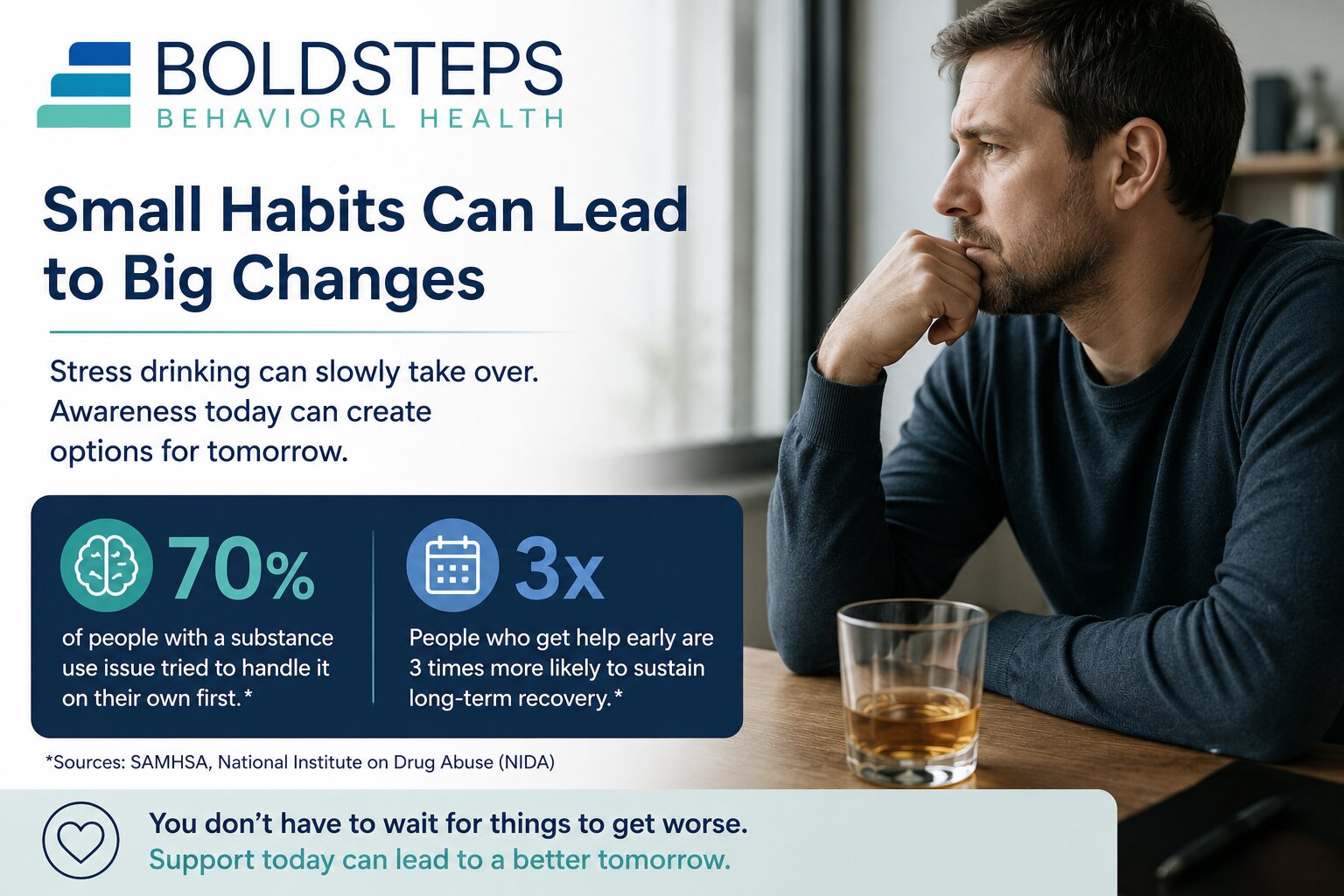
You Don’t Need a Rock Bottom to Change Direction
Many people delay seeking help because they’re waiting for proof.
Proof that things are serious enough.
Proof that they deserve support.
Proof that they’ve reached some invisible threshold.
The problem is that alcohol problems don’t come with warning labels.
Most people don’t realize how much drinking has affected their lives until they look back.
The better approach is responding early.
Addressing concerns while they’re still manageable.
Seeking support before the consequences become larger.
For many individuals, exploring help in local communities can provide a starting point that feels approachable and realistic.
You don’t need a crisis.
You don’t need a disaster.
You don’t need permission.
You only need honesty.
And if you’re asking whether stress drinking has become something more serious, that honesty may already be beginning.
Frequently Asked Questions
How do I know if stress drinking is becoming a problem?
A common warning sign is relying on alcohol as your primary way of coping with stress, anxiety, frustration, loneliness, or emotional discomfort.
Can someone have an alcohol problem while still working full-time?
Yes. Many people continue functioning at work and meeting responsibilities while privately struggling with alcohol dependence.
Is drinking every night considered alcoholism?
Not necessarily. However, nightly drinking can become concerning if it feels difficult to stop, continues increasing, or becomes necessary for relaxation or sleep.
What are some early warning signs that alcohol is becoming too important?
Frequent thoughts about drinking, difficulty cutting back, increased tolerance, emotional reliance, and drinking despite concerns are all important warning signs.
Why do I feel anxious when I try not to drink?
Alcohol can become tied to stress relief and emotional regulation. When it isn’t available, feelings that were previously numbed may become more noticeable.
I left treatment before. Can I come back?
Absolutely. Many people return to treatment after stepping away. Returning for support is common and does not mean you’ve failed.
Do I have to hit rock bottom before seeking help?
No. Early intervention is often easier and less disruptive than waiting until alcohol creates major problems in health, work, or relationships.
What if I’m not sure whether I need treatment?
You don’t need certainty to start a conversation. Many people begin by simply exploring options, asking questions, and learning what support might look like.
Call (401) 287-8652 or visit our intensive outpatient program services to learn more about our intensive outpatient program services in Rhode Island.